


Author: MOON TUTOR
-
From Design to Embroidery: The DST / DSI Workflow
Discover how a visual design becomes an embroidery programme – and why the decisions made before the machine starts can determine the quality of the final result.
-
Sewing vs. Embroidery: Machines and Process Logic
Discover what makes machine embroidery fundamentally different from conventional sewing – and why understanding the complete embroidery system is essential for professional customer support.
-

Read the back. Name the stitch.
LN 031 works backwards from the joint that has to be made: six stitch classes in ISO 4915, eight seam classes in ISO 4916, the machines that produce them, and the thread in each of four positions. It carries AMANN’s own consumption figures, and why a knit hem sewn as a flatseam takes ten times the thread of a lockstitch. Two seams can look identical on the face and be nothing alike on the back. LN 031, now in the AMANN Education Suite.
-

Material Damage and Needle Selection
What this module covers Material damage is what happens to the fabric and to the thread while a product is being made. LN-027 covers five mechanisms and how to tell them apart: a needle that cuts instead of displacing, a needle that runs hot enough to melt thermoplastic fibres, friction that opens the fibre surface, a seam structure that fails without any fibre being destroyed, and damage that is created in production but only becomes visible after washing. It adds the needle decisions behind most of them — size in Nm, cloth point against cutting point, needle condition and the…
-

Seam Defects
A customer rarely calls a thread supplier to discuss thread. They call because a seam has failed, the line is stopped, and you have ten minutes to say something that holds. LN 026 is about those ten minutes. You will learn what to secure before the machine is touched, how to read the stitch, the broken thread end and the needle hole in a fixed order, and how to tell — with evidence you can put in the customer’s hand — whether the thread is the cause. In eleven of thirteen patterns, it is at most a contributing factor.
-
Stitch Types and Thread Consumption
[ Under Construction ] Ask three people in a factory how much thread a jacket takes and you will get three answers. A seam is defined by three numbers — stitch type, seam type and stitch density — and all three move the thread requirement. The first moves it hardest: on the same material, a four-needle cover chainstitch takes ten times the thread of a lockstitch. LN-025 turns that relationship into a calculation you can carry out in front of a customer and defend line by line, from AMANN’s own published figures and the conditions they belong to.
-
Amann Thread Master
Understand the thread. Navigate the portfolio. Make the right choice. AMANN’s range covers everything from a classic cotton thread to aramids for protective clothing and cellulosic filaments from wood pulp. Learning it product by product takes a long time. Understanding the structure behind it takes about 20 minutes. THREAD MASTER is an interactive learning game built on one chain:raw material → construction → properties → size → application → product. You work through it step by step: identify what threads are made of, understand how the six construction types change the behaviour of a seam, place real products in the…
-
AMANN Group Portfolio
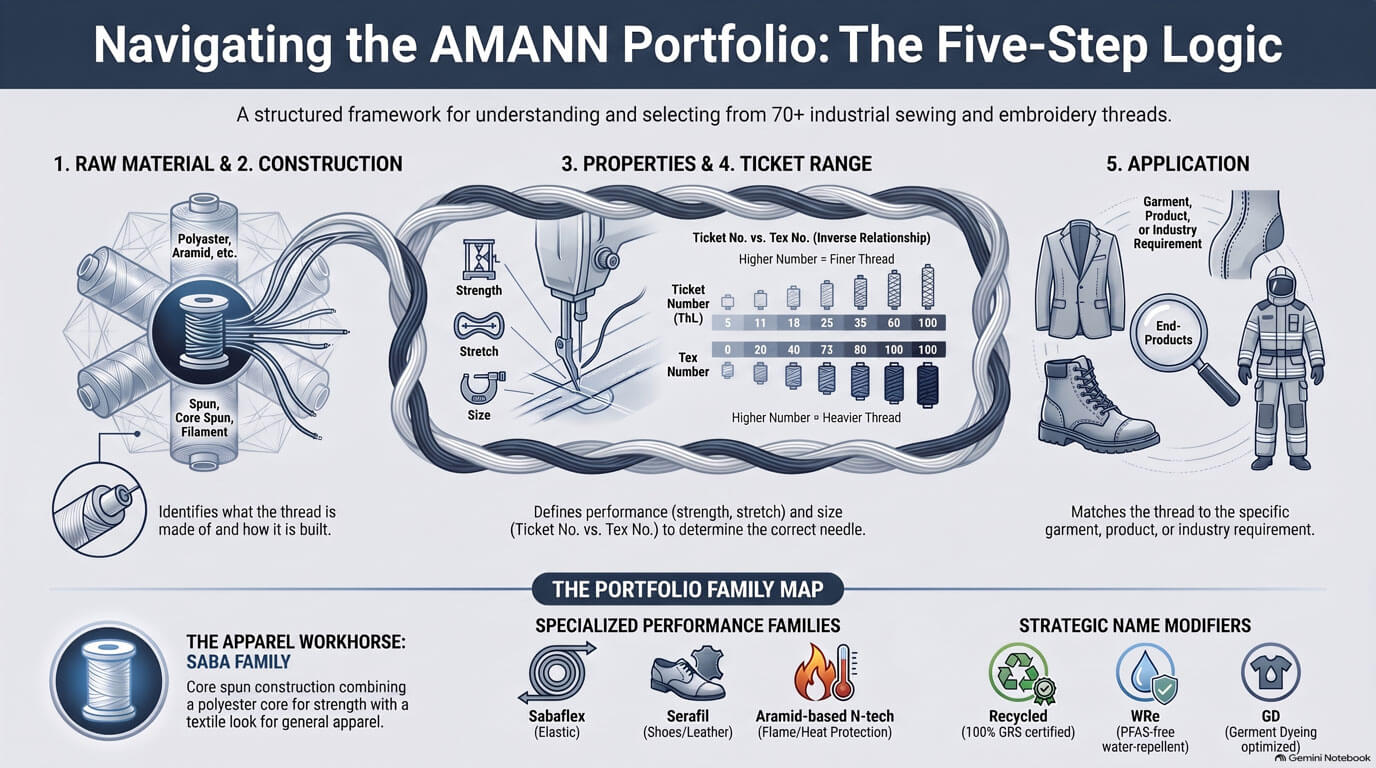
This nugget gives you the map. After working through it you can place any AMANN product, name the family that fits a customer requirement, and explain your choice in one sentence. No prior technical knowledge is needed.