


One ordering principle for more than 70 products
A sewing thread looks like a minor detail. In practice it decides whether a seam holds and whether a production line keeps running.
The AMANN range covers more than 70 products. At first sight that is a lot. It becomes manageable the moment you see that every single product is described by the same four facts — and always in the same order.
This nugget gives you the map. After working through it you can place any AMANN product, name the family that fits a customer requirement, and explain your choice in one sentence. No prior technical knowledge is needed.
The four questions behind every product
1. Which raw material?
The basic behaviour of the thread: strength, heat resistance, elasticity, appearance, ecological profile.
2. Which construction?
How the fibres are put together. The strongest single influence on how the thread sews and how the seam looks.
3. Which properties result?
Seam strength, abrasion resistance, sheen, softness, bulk, UV and chemical resistance.
4. For which application?
The segment and the seam type the product was developed for.
The fifth dimension is size. Within a family, the ticket range tells you which thicknesses are available. Material, construction and properties define what the thread is; the ticket number defines how thick it is.
Four facts about the company
- Founded in 1854 — more than 170 years of thread manufacturing. Many customers have used the same product family for decades.
- Six application segments: Apparel · Automotive · Shoes & Accessories · Embroidery · Home Interior · Techtex & Speciality. The segment is the fastest way to narrow the range down.
- More than 70 products in the public product overview — wide, but not arbitrary.
- “AMANN. Beyond Threads.” Customers buy the product and the technical support behind it. Portfolio knowledge is the part of that promise you deliver personally.
Step 1 — The raw material decides the basic behaviour
Polyester (PES) | the workhorse
High strength, dimensionally stable, good light and chemical resistance, low moisture uptake. In Serafil, Saba, Sabatex, Serabond, Isacord.
Polyamide (PA 6.6) | the tough one
Highest abrasion resistance and elasticity; takes peak loads without breaking. In Onyx, Strongbond.
Cotton (CO) | the natural fibre
Matt, heat-resistant in the seam, takes garment dyeing well, biodegradable. In Lifecycle Cotton and in the core-spun classics.
PTT / biopolymer | the elastic one
Highest elongation — a stretch reserve for elastic materials. In Sabaflex, made with 37 % biopolymers from renewable resources.
High-performance fibres | the specialists
Aramid, PTFE, PEEK, basalt, Dyneema®, silver-coated hybrids — for heat, cut and chemical resistance or conductivity. In the “-tech” range, Silver-tech, Xtreme-tech, GORE TENARA.
Rule of thumb: polyester for almost everything, polyamide where the seam is under mechanical stress, cotton where the article is dyed after making-up, and a specialty fibre only where a normal thread would fail.
Step 2 — The construction decides how it sews
The construction is the field directly under the raw material on every product page. It explains why two threads made from the same polymer behave completely differently. All eight constructions are covered in LN 019; these five you will meet every day.
Spun | staple fibres, twisted
Matt, textile look, soft hand. Example: Lifecycle Cotton.
Core spun | filament core, fibre sheath
Filament strength with a textile appearance. Examples: Saba, Rasant.
Continuous filament | endless filaments, smooth
Highest strength per diameter, plus a subtle sheen. Examples: Serafil, Onyx.
Texturised | crimped filaments
Soft, voluminous, skin-friendly; covers the edge in overlock seams. Example: Sabatex.
Bonded | filaments fixed together
The thread cannot untwist — essential for multidirectional sewing. Examples: Strongbond, Serabond.
Step 3 — The portfolio map: eleven families
Each entry reads in the order of the four questions: raw material · construction · ticket range, then what the product is for. These eleven families cover all six segments and every main construction. Everything else is either a variant of them or a specialty thread for a defined technical problem.
Saba | polyester/polyester · core spun · Tkt 8–180
The all-rounder. Closing and topstitch seams across apparel: ladies- and menswear, denim, workwear, children’s clothing. High abrasion resistance, textile appearance.
Rasant | polyester/cotton · core spun · Tkt 35–120
The traditional core spun thread. Robust in sewing, proven across many apparel applications; also matt embroidery.
Serafil | polyester · continuous filament · Tkt 7–80
High seam strength with a subtle sheen. Shoes, bags, suitcases, belts and small leather goods — closing and decorative seams.
Sabatex | polyester · continuous filament, texturised · Tkt 60–250
The bulk yarn: soft, voluminous, skin-friendly. All serging and coverstitch seams with optimal edge covering. Underwear, sportswear, home interior.
Sabaflex | PTT, 37 % biopolymer · continuous filament · Tkt 30–120
Highest elongation — a stretch reserve for every seam in elastic materials. Sportswear, underwear, workwear.
Onyx | polyamide 6.6 · continuous filament · Tkt 10–80
The ultra-strong thread for stressed seams: robust, abrasion-resistant, durable. Shoes, bags, technical textiles.
Strongbond | polyamide 6.6 · continuous filament, bonded · Tkt 8–80
Maximum seam durability and reliable multidirectional sewing. Leather goods, shoes, luggage.
Serabond | polyester · continuous filament, bonded · Tkt 6–60
Outstanding UV resistance through special dyestuffs. Outdoor textiles, awnings, covers, home interior.
Lifecycle Cotton | 100 % organic cotton · spun, mercerised · Tkt 18–60
Developed for the biological cycle: extra-long-staple mercerised organic cotton, compostable dyes, Cradle to Cradle Certified® Gold. Garment dyeing, apparel.
Isacord | polyester or 100 % recycled polyester · continuous filament, trilobal · Tkt 40
The machine embroidery standard: brilliance, excellent colour fastness, abrasion-resistant. The recycled version is GRS certified.
Silver-tech | silver-coated polyamide/polyester · hybrid · Tkt 50 and 120
Conductive seams and surfaces, and seam positions requiring antimicrobial behaviour. Smart textiles, medtech.
Step 4 — The two numbers on the thread
Every product carries two figures, and they work in opposite directions. This is the most frequent misunderstanding in customer conversations.
Ticket No. (Tkt) | inverse
The commercial size number used across the industry. The higher the number, the finer the thread. Tkt 8 is a heavy decorative thread, Tkt 180 a fine thread for lightweight fabrics.
Tex No. | direct
The linear density: the weight in grams of 1,000 metres of thread. The higher the number, the heavier and thicker the thread. Used for specification and comparison.
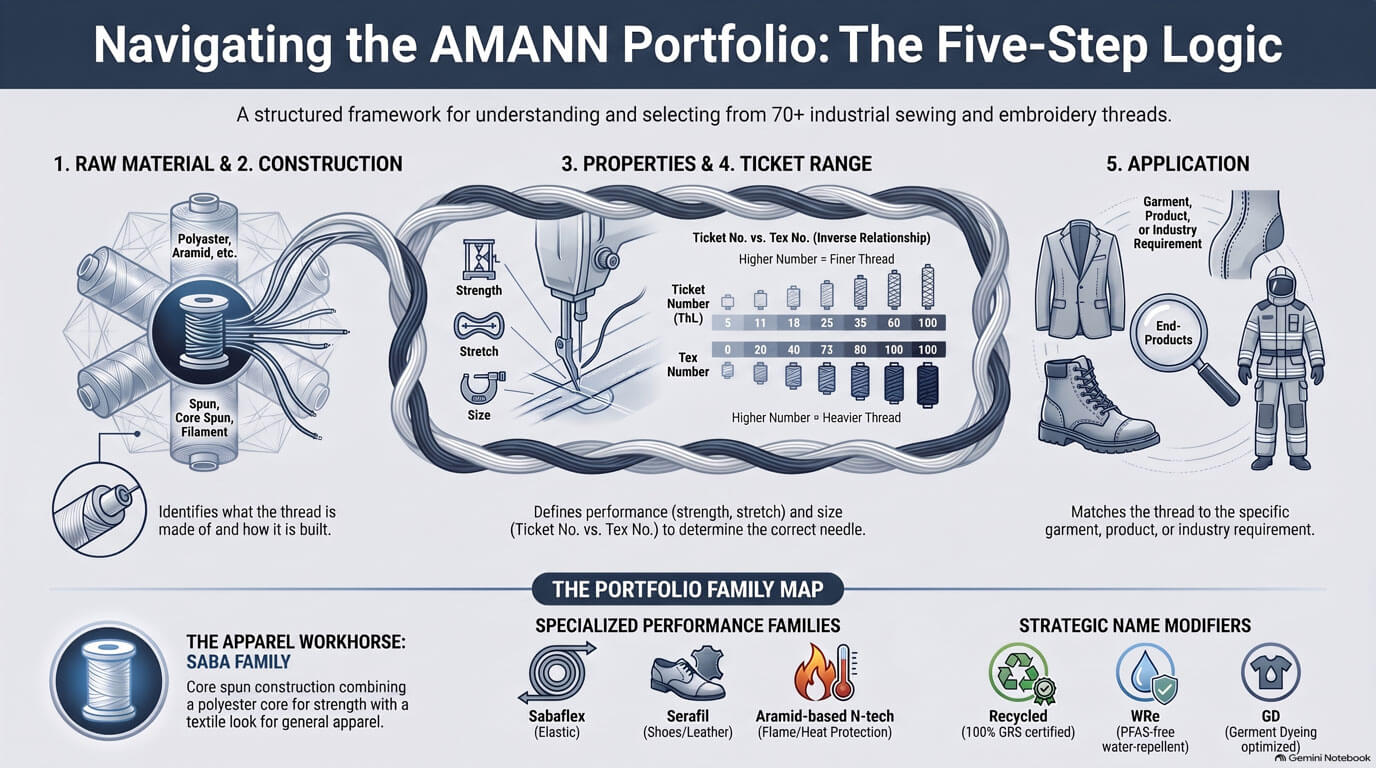
One family, all four sizes — Sabaflex: Tkt 30 = 105 Tex · Tkt 50 = 70 Tex · Tkt 80 = 60 Tex · Tkt 120 = 27 Tex. The rule to remember: ticket number up, thread down. A customer asking for a finer thread is asking for a higher ticket number — and usually for a finer needle with it.
Step 5 — Name modifiers: the range within the range
Most products beyond the eleven families are not new families. They are defined variants, and the addition to the name says which need the variant solves. Once you know the modifiers, you can read a product name you have never seen before.
Recycled | sustainability
Made from 100 % recycled raw material, GRS certified. Serafil Recycled, Saba Recycled, Sabatex Recycled, Isacord Recycled — same performance, better footprint.
WRe | water repellency
Water-repellent finish, 100 % PFAS-free. Serafil WRe, Saba WRe, Onyx WRe, Serabraid WRe — for shoes, outdoor and automotive seams exposed to moisture.
GD | garment dyeing
Optimised for garment dyeing: the thread takes the dye together with the garment. RasantGD, MercifilGD.
fine | fineness
Finer filament version of the family. Serafil fine — delicate, semi-transparent, for fine materials.
Soft | hand
Microfilament version with a softer hand. Sabatex Soft — lingerie, activewear, skin contact.
Evo | evolution
Further development of an established family. Saba Evo — the premium version for superior seam uniformity.
-tech | technical range
The technical and high-performance products: N-tech, A-tech, K-tech, Basalt-tech, Silver-tech, Xtreme-tech with Dyneema®.
Combinations follow the same logic: Serafil Recycled WRe is the Serafil family, made from recycled polyester, with the PFAS-free water-repellent finish. Family — material — function, in that order.
Sustainability sits inside the range, not beside it
The sustainable lines are not a separate catalogue. They sit in the established families as recycled or bio-based variants — which is what makes them easy to recommend: the customer keeps the product he knows and changes only the raw material.
- Recycled variants of the leading families — Serafil, Saba, Sabatex, Strongcore, Isacord — GRS certified, same sewing performance.
- Lifecycle Cotton for the biological cycle: organic cotton, compostable dyes, Cradle to Cradle Certified® Gold.
- The WRe finish replaces PFAS chemistry in water-repellent products.
- OEKO-TEX® STANDARD 100 across the range; Pro-Care certification where industrial laundry matters.
- Design for disassembly: Smart Stitch™, a heat-dissolvable thread, and Waterfil, a water-soluble thread for temporary seams.
Presented at Texprocess 2026: AeoniQ™ Fil (Texprocess Innovation Award, category Ecological Quality), Smart Stitch™, Waterfil, Sera & Isa Reflect, Saba Evo and Isacord Recycled UV.
From customer requirement to product
This is the step that matters in the conversation. Read the requirement, identify the decisive property, name the family — then refine with ticket number and modifier.
“The denim topstitch has to be visible and must not break.” | strength with a matt look
Saba in a coarse ticket, alternatively Rasant.
“The shoe seam is visible and gets wet.” | sheen plus water repellency
Serafil WRe.
“The overlock seam on the underwear chafes.” | softness and edge covering
Sabatex, or Sabatex Soft.
“The seam tears when the material stretches.” | elongation
Sabaflex.
“The awning has to survive several summers.” | UV resistance, no untwisting
Serabond.
“We dye the shirts after making-up.” | dye uptake with the garment
RasantGD or MercifilGD.
“We need a conductive seam in a sensor textile.” | conductivity
Silver-tech.
How to use this nugget
Podcast | approx. 8 min
The overview, hands-free: the ordering principle, the eleven families and the modifiers, spoken. Ideal before a customer visit.
Slide show | approx. 10 min
The guided version: the portfolio map, the two numbers and the application mapping as visuals.
PowerPoint | download
The reference file — to look things up, and as the basis for training in your own team or region.
Recommended sequence: listen to the podcast once, work through the slide show, then keep the PowerPoint at hand for the first weeks of customer contact.
Where this nugget sits in the learning path
LN-022 belongs to the Value Stream path. It is the frame that holds the five stages together — the depth of each stage stays in its own nugget, so nothing is taught twice.
- LN 017 — AMANN Value Stream, from fibre to finished application: the five-stage path this nugget applies.
- LN 018 — Fibre identification and the burn test: stage 1, raw material.
- LN 019 — The eight yarn constructions: stage 2, construction.
- LN 020 — Resulting thread properties: stage 3.
- LN 021 — The ticket range and Tex number system: stage 4, the two numbers.
- LN 024 — THREAD MASTER, the learning game: consolidates the whole path.
Check yourself
You have understood this nugget when you can answer these five questions without looking them up.
- Which four questions describe every AMANN product, and in which order?
- Which is the thicker thread, Tkt 30 or Tkt 120 — and why?
- A customer needs a soft overlock seam on lingerie. Which family, and which construction is behind it?
- What do the additions Recycled, WRe and GD stand for?
- Which family would you offer for a seam that has to survive years of sunlight, and what makes it suitable?
Podcast: The Engineering Logic Of Industrial Sewing Threads