The story of MOON begins with a simple but unsettling observation: the European textile industry, with its 250-year history, was standing at a crossroads. Rising energy and raw material costs, global competition from high-capacity regions, new regulatory pressures from the European Green Deal and the Sustainable Development Goals, and a massive shortage of skilled workers were putting many companies under existential pressure. At the same time, the public debate was dominated by the myth of “disruption” – the idea that a single breakthrough technology would either save or wipe out entire industries. When the analytical groundwork for MOON was laid, it became clear that such a silver bullet does not exist for textiles. What the industry truly needed was not one miracle invention, but a structured path for ecological, economic and social transformation, grounded in real markets and real companies.
As the Hans A. Pielenz Foundation, we decided to support this path because it perfectly aligned with our mission: to strengthen competencies, make knowledge accessible and enable responsible transformation in business and society. Together with AFBW and in cooperation with Gherzi Germany, a comprehensive study was launched. It combined a screening of almost one hundred recent publications, 107 interviews with entrepreneurs, researchers and investors, a global analysis of research and patent activities, and interdisciplinary expert workshops with impulses from other industries such as telecommunications, energy and pharmaceuticals. The conclusion was sobering and encouraging at the same time: there was no single disruptive technology that would reshape the textile world, but there were enormous opportunities in new value-stream designs, circular business models and innovative forms of collaboration along the supply chain.
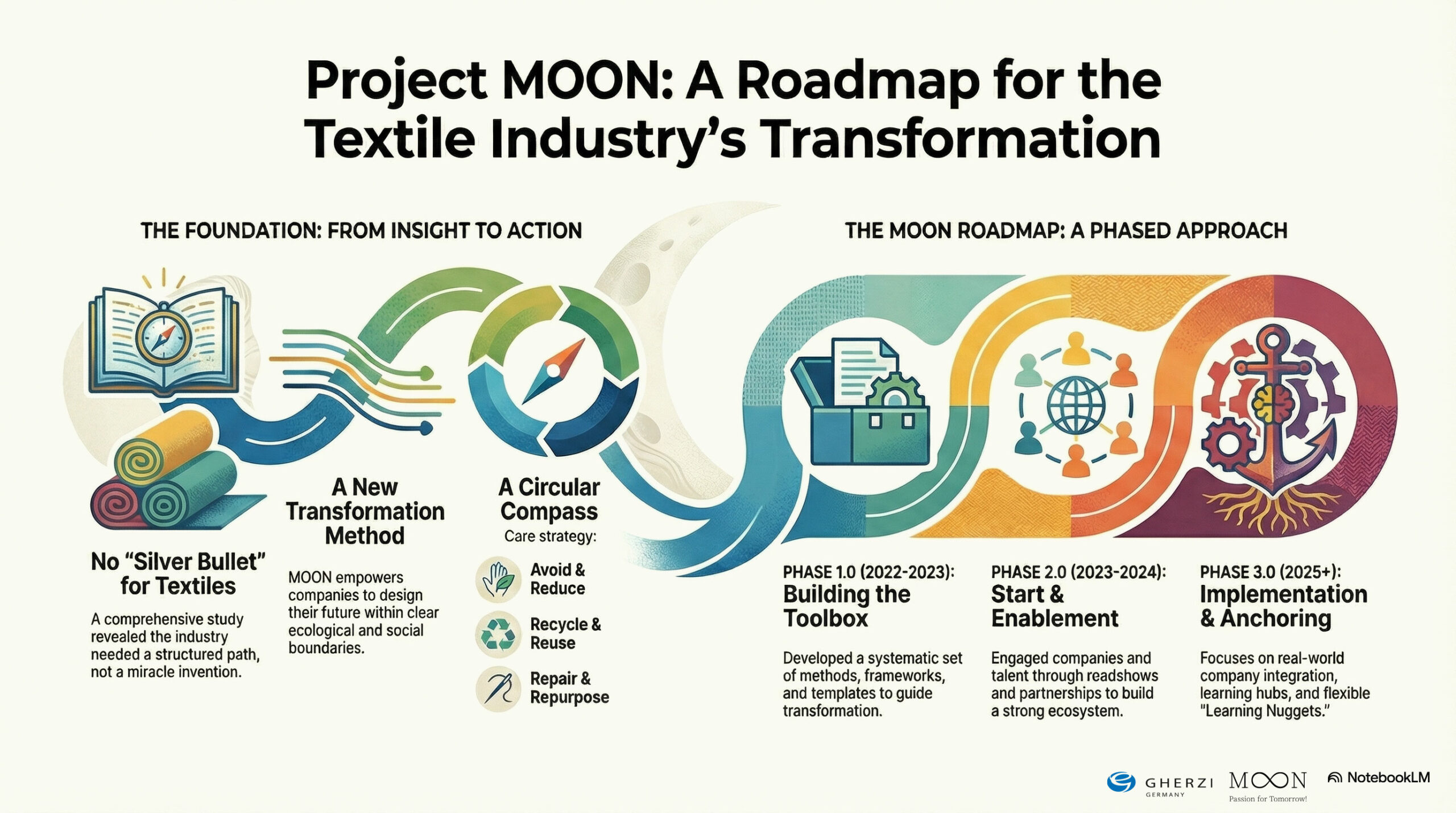
From this insight, Project MOON was born – initially as a research-based roadmap, then as a practical transformation method. The core idea was simple: if disruption is rare and markets decide everything, then companies must be empowered to design their own future within clear ecological and social boundaries. MOON translated the findings of the study into a method that helps companies position themselves in the global textile landscape, understand their technological and organizational maturity, and derive concrete strategic options in line with the Green Deal. The guiding principle “avoid & reduce, recycle & reuse, repair & repurpose” became the ethical and economic compass for all further work.
MOON 1.0, implemented between May 2022 and May 2023, turned this concept into a systematic toolbox. In this first phase, a coherent set of methods, frameworks and training materials was developed to support the transformation of strategies, business models, processes and value streams. The result was the MOON Toolbox with an accompanying database and practice-tested templates, complemented by an overarching MOON concept that serves as a reference model for application and continuous improvement. When this phase was successfully completed – mission accomplished – the foundation had what it had aimed for: a robust, scientifically grounded and practically usable method that any interested company could apply, regardless of its size or position in the value chain.
However, a method alone does not change an industry. That is why MOON 2.0, from January 2023 to November 2024, focused on “Start & Enablement”. In this second phase, companies, associations and young talents across the DACH region were actively engaged through roadshows, university workshops and targeted networking formats. Partnerships were established with organizations such as Fashion for Good, textil+mode and Bayern Innovativ, creating a growing ecosystem around MOON. The outcome was a reliable transformation pipeline, a strengthened partner network and secure access to innovation and talent. For the Hans A. Pielenz Foundation, this phase was crucial: it showed that MOON was not just an academic study, but a living platform that could mobilise people, institutions and ideas for a sustainable textile future.
With this momentum, the project entered MOON 3.0, the phase of “Implementation & Anchoring”, starting in December 2025. In the subproject MOON 3.0_A1, change measures are no longer only planned on paper, but integrated into structures, processes and communication cultures in real companies. Pilot implementations – among them AMANN UK – apply the MOON method in practice. The Learning Hub AMANN UK is being developed as a central node for knowledge transfer and transformation training, based on an explicitly anthropocentric approach: employees, teams and leadership culture are placed at the centre. Here, the foundation’s funding objective becomes tangible: transformation is not only about technology and compliance, but about people who are able and willing to shape change in their everyday work.
MOON 3.0_A2 builds directly on this. The Learning Suite created for the shopfloor in 3.0_A1 is expanded and professionalised for employees with interface and control responsibilities – the “second level” of organisations. These are the people who coordinate processes, link departments and carry transformation into their units. By turning the Learning Suite into an open training and transfer instrument at expert level, MOON 3.0_A2 accelerates learning processes, strengthens individual capabilities and fosters a sustainable learning culture. For the Hans A. Pielenz Foundation, this is a central lever: deep knowledge is not meant to stay in isolated centres of excellence, but to be shared, multiplied and made accessible as a common resource for the industry and for society.
In parallel, MOON 3.0_B1 addresses another strategic need identified early in the study: the demand for fast, flexible learning beyond the shopfloor. In many functions – sales, communication, project management, service – new topics and requirements emerge at short notice, and traditional training formats are too slow and rigid. MOON 3.0_B1 therefore develops dynamic “Learning Nuggets”: short, modular units that enable rapid, needs-driven knowledge transfer across different corporate areas. By connecting these micro-learnings into a coherent architecture, MOON creates a holistic approach to competence development that links various functions, synchronises learning processes and anchors dynamic learning across the entire organisation.
Looking back, the Hans A. Pielenz Foundation chose to support MOON because it embodies exactly the kind of transformation we believe is necessary for the future: fact-based instead of ideological, collaborative instead of isolated, evolutionary rather than driven by disruption hype. The project emerged from a rigorous analysis of the textile industry’s situation, it respects the realities of markets and companies, and it turns regulatory pressure from the Green Deal into opportunities for new business models and regional value creation. By funding MOON, we are helping to ensure that the textile industry – and the many people whose livelihoods depend on it – can navigate this turning point with confidence, creativity and a clear sense of responsibility for the common good.