


The Model at a Glance
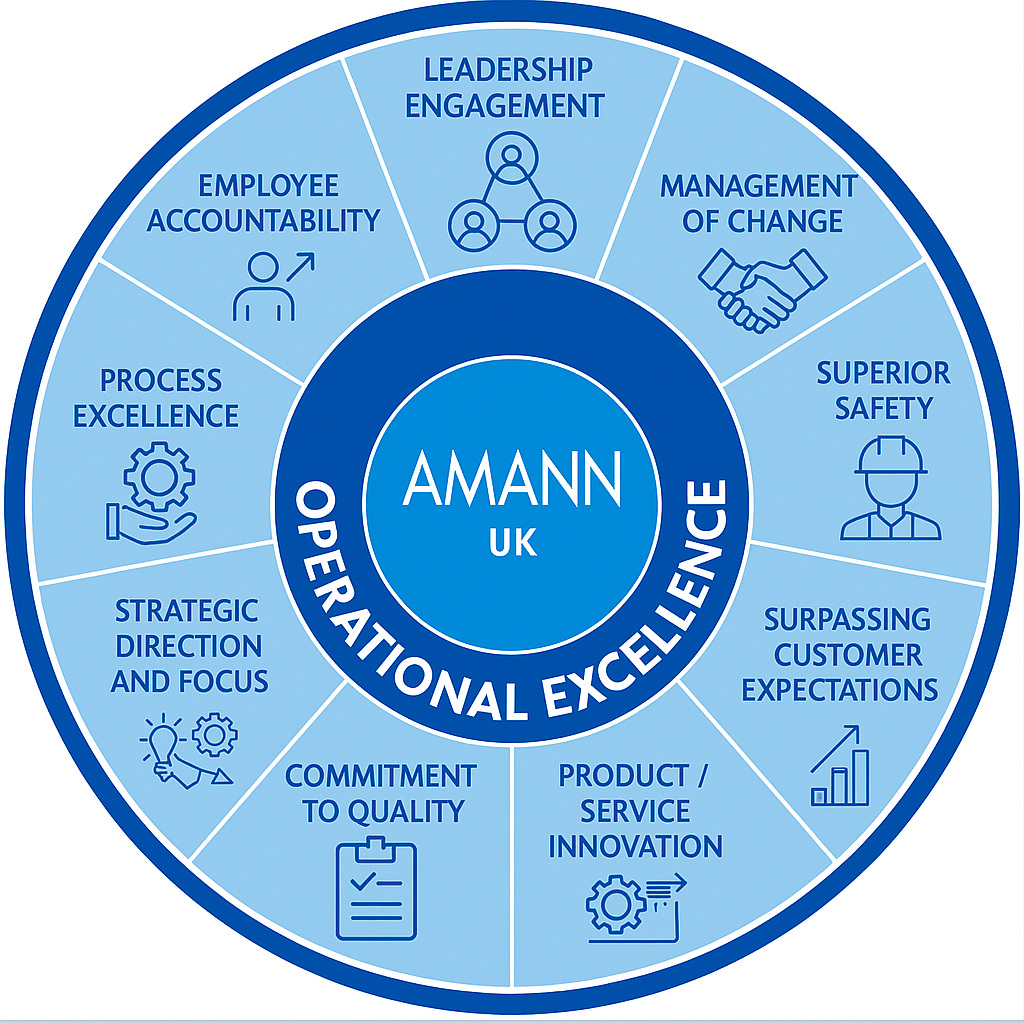
At the centre sits AMANN UK; around it, the ring Operational Excellence—our commitment to continuously improve performance and collaboration. The outer segments explain how we deliver and what it feels like on the shop floor:
- Leadership Engagement: Leaders at the gemba—listening, clearing obstacles, making goals visible.
- Employee Accountability: Everyone owns outcomes — Safety, Quality, Delivery, Cost and People.
- Management of Change: Disciplined, transparent PDCA with the people affected.
- Process Excellence & Safety: Standard work, 5S, visual management, zero-harm for stable, safe flow.
- Strategic Direction & Focus: A shared North Star that guides daily priorities.
- Commitment to Quality: Build quality in—from first filament to final packaging.
- Product / Service Innovation: Frequent kaizens that compound to big results.
- Customer Performance: Decide by customer value—OTIF, quality, speed.
- Business Growth & Partnerships: Grow through trust—teams, suppliers, customers.
How it looks on the shop floor (Daily Practices)
- Daily control: 10-minute huddle at the visual board (Safety • Quality • Delivery • Cost • Ideas • People).
- See problems, solve problems: Treat deviations as opportunities; go to root cause; protect/upgrade the standard.
- Work with respect: Listen, support across functions, give clear and appreciative feedback.
- Learn in flow: Each shift leaves the process better—visible, measurable, shared.
Try-it-Now (Next Shift Actions)
- Run the huddle: Review yesterday’s SQDCI, call out one risk, one improvement, one support need.
- Spot waste: During the shift, note one delay, rework, or motion waste; log it on the board.
- Mini-PDCA: Pick one issue; define problem → test a small countermeasure → check result → update standard if effective.
- 5S sweep (5 minutes): Remove one unneeded item, label one location, clean one hazard area.
Quick Check (Answer mentally or with your team)
- True/False: Quality is primarily achieved by final inspection.
- Which metric best shows customer value discussed at the board: OTIF, OEE, or headcount?
- Name two leader behaviors that demonstrate Leadership Engagement.
- What does the “C” in PDCA stand for, and when do we do it?
- Give one example of “build quality in” for our processes.
(Suggested answers: 1=False; 2=OTIF; 3=Be at the gemba, remove obstacles/make goals visible; 4=Check—after the test/run; 5=e.g., poka-yoke/first-piece check/standard work with visual limits.)
Reflection Prompts
- Where does our current board help (or fail to help) me make better decisions during the shift?
- Which step of PDCA do we rush—and what will I do differently this week?
- What is one respectful behavior I’ll practice in today’s cross-functional handover?
- Which customer metric would change if our cell reduced one source of rework?
Micro-Glossary
- Gemba: The real place where work happens.
- PDCA: Plan–Do–Check–Act, a disciplined improvement cycle.
- 5S: Sort, Set in Order, Shine, Standardize, Sustain.
- Standard Work: The best known method—documented, visible, repeatable.
- Visual Management: Make status and standards visible at a glance.
- Kaizen: Small, continuous improvements by those who do the work.
- OTIF: On Time, In Full; key customer performance measure.
Measures of Success (What “good” looks like)
- Huddles happen daily, on time, under 10 minutes, with clear actions and owners.
- At least one kaizen logged per team per week; PDCA trials visible on the board.
- 5S audits trending up; fewer repeat defects; improved OTIF and fewer stoppages.
- Respectful interactions observed across shifts and functions.
Facilitator Tips (for Supervisors/Leads)
- Open with “why it matters” for today’s orders and customers.
- Keep the board live: update data before the huddle; close yesterday’s actions.
- Celebrate small wins; make problems safe to surface; always link back to the model.
Call to Action:
Choose one behavior to start today (e.g., a tighter 10-minute huddle or one mini-PDCA). Share your result at tomorrow’s board. That’s the AUK WAY—everyone, every day.
The circular model makes this culture tangible. At the centre sits AMANN UK; around it, the ring Operational Excellence—our commitment to continuously improve performance and collaboration. The outer segments explain howwe deliver and what it feels like on the shop floor:
- Leadership Engagement – Leaders are present at the gemba, listen, remove obstacles, and make goals visible.
- Employee Accountability – Everyone owns outcomes: safety, quality, delivery, and the shift’s performance.
- Management of Change – Change follows a disciplined, transparent PDCA approach with the people affected.
- Process Excellence & Safety – Standard work, 5S, visual management, and zero-harm thinking create stable, safe flow.
- Strategic Direction & Focus – We know our “North Star” and align daily priorities to it.
- Commitment to Quality – Quality is built in, not inspected in—from the first filament to final packaging.
- Product / Service Innovation – Continuous improvement through small, frequent kaizens that add up to big results.
- Customer Performance – Decisions are judged by customer value: OTIF, quality, and speed.
- Business Growth & Partnerships – We grow through trust—within teams, with suppliers, and with customers.
How the picture becomes daily practice on the shop floor:
- Daily control: Short, focused team huddles at visual boards—Safety, Quality, Delivery, Cost, Ideas—keeping everyone aligned.
- See problems, solve problems: Deviations are opportunities. We talk facts, go to root cause, and protect the standard.
- Work with respect: We listen, support across functions, and give clear, appreciative feedback.
- Learn in flow: Every shift leaves the process better—visible, measurable, and shared.
The AUK WAY means we see the whole system and our role within it. We work safely, cleanly, and to standard; we decide close to the customer and on data; and we treat one another with respect. That is how we drive shop-floor performance—reliably, sustainably, and with pride in our craft.
AMANN Education Hub – Reflection Questions
Think About It
- How can you make SIC part of your team’s daily routine to create real improvements?
- How can I, as an Operational Leader, effectively leverage the SIC tool together with my team to sustainably improve efficiency and productivity within our area of responsibility at the AMANN Group?
By reflecting on these questions, consider not only how SIC can support structured communication and problem-solving, but also how involving your team fosters ownership, continuous improvement, and shared responsibility for operational excellence.
Helpful Resources and Links
- LeanProduction.com – What is SIC?
https://www.leanproduction.com/short-interval-control/ - Vorne Industries – Complete Guide to SIC
https://www.vorne.com/learn/silver-bullets/short-interval-control/ - LearnLeanSigma – How to Start with SIC (6 steps) https://www.learnleansigma.com/control/short-interval-control-in-6-steps/#google_vignette
- Tervene – SIC in Modern Manufacturing
https://tervene.com/blog/sic-manufacturing/ - Toyota Global – The Toyota Production System (TPS) https://global.toyota/en/company/vision-and-philosophy/production-system/index.html
- AllAboutLean – Introduction to Lean Thinking https://www.allaboutlean.com/firstlecture_hom_4/
- Wikipedia – Lean Manufacturing Overview https://en.wikipedia.org/wiki/Lean_manufacturing
Glossary of Terms & Abbreviations
Lean & Flow Fundamentals
- Cell / U-Cell — Compact, process-oriented layout (often U-shaped) enabling one-piece flow, visual control, and multi-skilled operation.
- One-Piece Flow — Movement of units one at a time (or one small lot) through consecutive steps with minimal buffers.
- Takt Time (TT) — Available production time per period ÷ customer demand; the pace at which the cell must produce.
- Cycle Time (CT) — Time to complete one unit or cycle at a workstation/process.
- Lead Time (LT) — Elapsed time from order to delivery; includes processing and waiting.
- Work in Process (WIP) — Inventory between start and finish of a value stream.
- Bottleneck / Constraint — Process with the least capacity that limits overall throughput.
- Value Stream Mapping (VSM) — End-to-end visualization of material and information flow to identify waste.
- Yamazumi (Balance Chart) — Stacked bar chart used to balance workload across operators or steps.
- Heijunka (Leveling) — Smoothing of volume and mix to stabilize flow and resources.
- Pitch — Fixed time interval that links planning to the shop floor (often TT × pack size).
- Gemba — “The real place” where value is created; go-and-see management practice.
Methods, Systems & Visual Control
- SMED (Single-Minute Exchange of Dies) — Reducing changeovers by shifting internal to external tasks and simplifying setup.
- Kanban — Pull signal (card/bin/electronic) to replenish only what is consumed.
- Supermarket — Controlled buffer with set min/max to decouple processes.
- FIFO Lane — First-in-first-out queue to preserve sequence and lead-time predictability.
- Andon — Visual/audible alert for status and abnormalities; empowers stop-to-fix.
- Poka-Yoke — Error-proofing devices or methods preventing defects at the source.
- Jidoka — Built-in quality and autonomous stop upon abnormality.
- Standard Work (SW) — Best-known method combining standard sequence, time, and WIP for stability.
- Skill Matrix — Visual grid of operator capabilities vs. tasks to plan cross-training and coverage.
- PFEP (Plan for Every Part) — Structured data set for each item: supplier, pack, storage, delivery, usage.
Quality & Industrial Engineering
- FPY (First-Pass Yield) — % of units passing a process without rework.
- OEE (Overall Equipment Effectiveness) — Availability × Performance × Quality.
- CTQ (Critical to Quality) — Product/process attributes vital to the customer (e.g., shade, tensile).
- SPC (Statistical Process Control) — Control charts to monitor stability and variation.
- Cp / Cpk — Process capability indices vs. specification limits (centering accounted in Cpk).
- FMEA / RPN — Failure Mode & Effects Analysis; Risk Priority Number ranks failure risk.
- MSA (Measurement System Analysis) — Studies (e.g., Gage R&R) to validate measurement reliability.
- SOP (Standard Operating Procedure) — Controlled instruction document for consistent execution.
- PPAP (Production Part Approval Process) — Formal approval package for customer/launch readiness (if required by sector).
Planning, Logistics & Business KPIs
- MRP / ERP — Material Requirements Planning; Enterprise Resource Planning systems for planning/integration.
- MES — Manufacturing Execution System (dispatching, tracking, parameters, traceability).
- BOM — Bill of Materials; structured list of components/consumables (e.g., yarn, dyestuff, lubricant).
- SKU — Stock Keeping Unit; unique item code.
- MOQ — Minimum Order Quantity set by supplier or economics.
- VMI — Vendor Managed Inventory; supplier monitors and replenishes stock.
- OTIF (On-Time In-Full) — Delivery reliability metric.
- EPEI (Every Part Every Interval) — Time to cycle through the full product family at leveled conditions.
- COGS / CoO — Cost of Goods Sold / Cost of Ownership; key financial metrics for decisions.
- Postponement — Delaying final differentiation (e.g., dyeing/color) to reduce inventory and improve responsiveness.
Sewing Thread – Process & Product Terms
- Winding — Forming yarn packages (cones/bobbins) suitable for downstream processes.
- Twisting — Combining filaments/plies to achieve target structure, strength, and handle.
- Heat-Setting — Thermal stabilization to lock twist and dimensional stability.
- Dyeing — Applying dyestuffs to achieve target shade; batch or continuous methods.
- Lubrication / Finishing — Applying finishes (e.g., silicone, wax) to control friction, heat, and sewability.
- Spooling / Rewinding — Transferring thread onto final delivery package (e.g., king spool, cone) to spec.
- Shade — Perceived color of dyed thread vs. standard.
- ΔE (Delta E) — Numeric color difference vs. standard (instrumental colorimetry).
- Package Density — Mass per unit volume on the package; impacts dye penetration and drying.
- Lot / Dye Lot — Traceable batch with homogeneous parameters and history.
- Tex / dtex / Denier — Linear density units (Tex=g/1000 m; dtex=g/10,000 m; Denier=g/9000 m).
- Count (Ne / Nm) — Cotton metric (Ne) or metric count (Nm) indicating fineness in indirect systems.
- TPI / TPM (Twist per Inch / Meter) — Twist level applied to the yarn/thread.
- Tenacity / Tensile Strength — Load at break normalized by linear density / absolute; key performance measure.
- Elongation at Break — % extension at failure; critical for seam performance.
- Coefficient of Friction (CoF) — Sliding resistance; strong driver of needle heat and sewability.
- Lube Pickup (%) — Mass of finish taken up by the thread; affects CoF and handling.
- Hairiness — Surface fibers protrusion; impacts appearance, friction, and linting.
- Moisture Regain — % moisture absorbed under standard conditions; affects weight and dyeing.
- Core-Spun — Filament core (e.g., polyester) wrapped by staple fibers (e.g., cotton) for strength/handle.
- Ply — Number of combined ends (e.g., 2-ply, 3-ply).
- Package Types — Cones, tubes, king spools, cops; defined by geometry and capacity.
Compliance, Safety & Sustainability
- REACH / RoHS — EU regulations controlling chemicals and hazardous substances.
- ZDHC — Zero Discharge of Hazardous Chemicals program/guidelines.
- MSDS / SDS — (Material) Safety Data Sheet for chemicals used in production.
- Higg Index — Tools to measure sustainability performance (facilities/materials).
- EHS — Environment, Health & Safety; regulatory and internal standards.
- Traceability — Ability to track materials, parameters, and lots through the value stream.
Cross-Site & Global Operations
- Master Recipe / Golden Batch — Harmonized, validated process parameters used as cross-plant standard.
- Process Window — Approved parameter ranges guaranteeing capability (e.g., temp, time, tension).
- Tech Transfer — Structured replication of a process/cell to another site (documents, training, run-at-rate).
- Run at Rate (R@R) — Verified production at the required volume and quality before release.
- Obeya — Large visual management room for cross-functional coordination and problem-solving.
- A3 — Structured problem-solving/reporting method on a single A3 page.