



Cellular Manufacturing – Learning Nugget
By organizing resources into independent, self-sufficient cells aligned to product families, cellular manufacturing delivers faster flow, lower waste, and higher flexibility—particularly valuable where products are varied but share common processing routes.
Cellular manufacturing creates an efficient, flexible, and waste-minimizing production system by organizing resources into independent, self-sufficient cells—especially valuable in industries producing varied but related products.
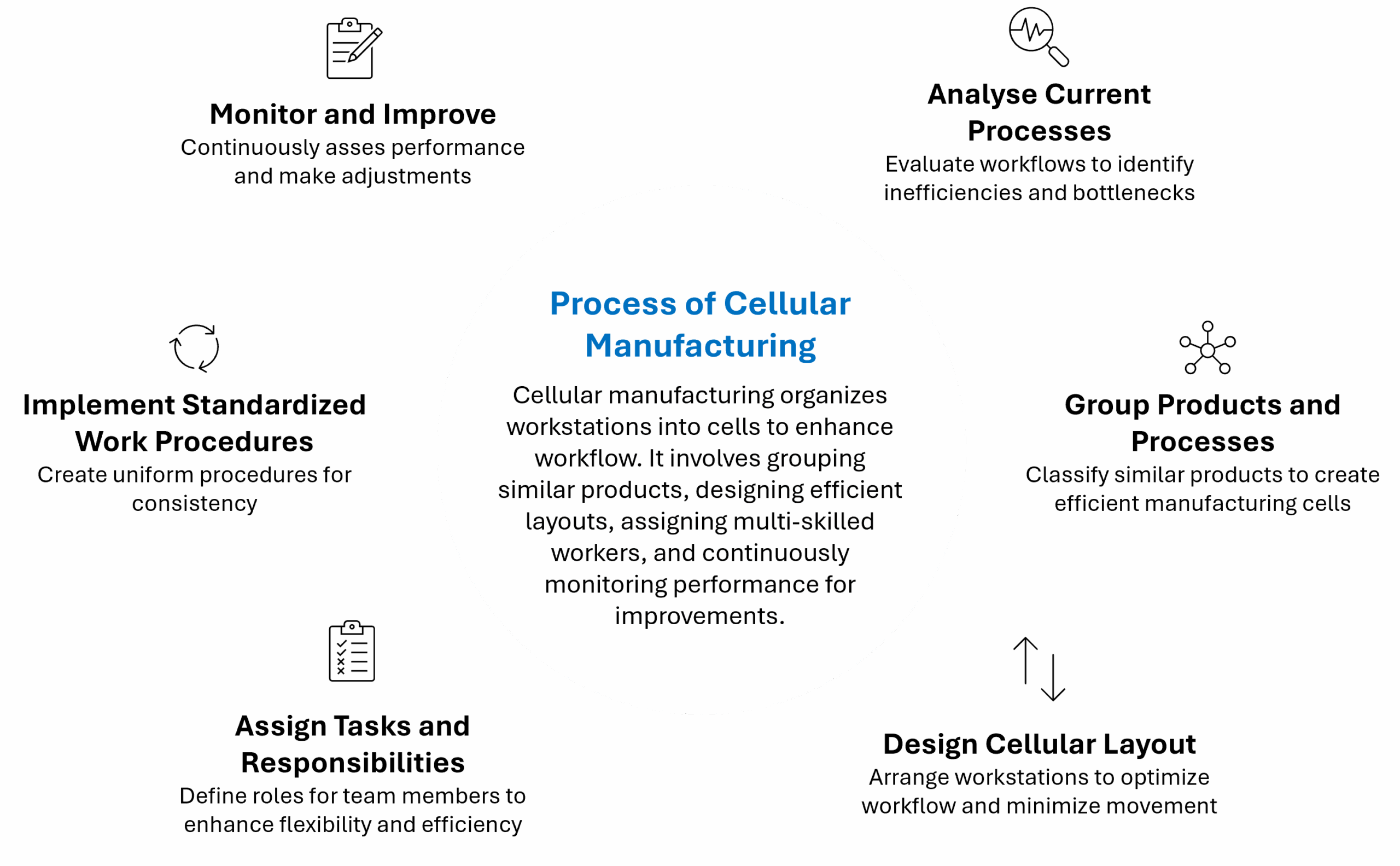
1. Definition
- A lean manufacturing method.
- Workstations are organized into specialized cells.
- Designed to efficiently produce families of similar products.
2. Primary Objectives
- Minimize waste across all stages of production.
- Accelerate production flow to reduce lead time.
- Increase flexibility to respond to customer demand.
- Enhance overall productivity and efficiency.
3. Major Benefits
- Waste Reduction: Eliminates non-value-adding activities (e.g., excessive inventory, unnecessary transport, and waiting times).
- Productivity Gains: Reduces setup and lead times, lowers work-in-progress (WIP), and decreases material handling requirements.
- Flexibility: Cells can quickly adapt to product variations and demand changes.
- Sustainability: Decreases environmental impact.
- Cost Efficiency: Lowers capital requirements.
4. Operational Principles
- Grouping: Similar parts or products are clustered into product families.
- Cell Structure: Each cell contains all necessary machines, tools, and resources.
- Workforce: Employees are cross-trained to perform multiple tasks within the cell.
- Flow: Products move sequentially through cells, one at a time, minimizing logistical effort and waste.
5. Comparison to Traditional Manufacturing
- Traditional Production Lines: Best suited for high-volume, standardized products.
- Cellular Manufacturing: Best suited for varied products within a family; allows more independence and adaptability in production.
6. Industry Example – Automotive Manufacturing
- Engine Cell: Completes all engine subassembly tasks.
- Body Cell: Responsible for car body subassemblies.
- Interior Cell: Handles interior component assemblies.
- Each cell:
- Operates independently.
- Contains required machines, tools, and cross-trained workers.
- Contributes to the overall assembly process efficiently.
Core Insight: Cellular manufacturing creates an efficient, flexible, and waste-minimizing production system by organizing resources into independent, self-sufficient cells—especially valuable in industries producing varied but related products.
Review Questions (Self-Check)
- What is the primary goal of cellular manufacturing?
- Which types of waste does cellular manufacturing aim to eliminate?
- How does cross-training of workers support efficiency in cellular manufacturing?
- In what way does cellular manufacturing differ from traditional production lines?
- Can you explain how the automotive industry applies cellular manufacturing in practice?
- What are the main productivity improvements achieved through this approach?
Recommended Further Reading & Resources
- “Lean Thinking: Banish Waste and Create Wealth in Your Corporation”
by James P. Womack & Daniel T. Jones – Classic book on lean manufacturing principles, including cellular systems. - “The Toyota Way: 14 Management Principles from the World’s Greatest Manufacturer”
by Jeffrey K. Liker – Explores lean practices and real-world applications of cellular manufacturing in Toyota. - MIT Lean Enterprise Institute – www.lean.org
Comprehensive online resource for lean principles, case studies, and implementation strategies. - iSixSigma – Cellular Manufacturing Overview – www.isixsigma.com
A clear and practical introduction to cellular manufacturing with examples and benefits.
Reflection Questions for AMANN Group
- Customer Takt & Flow Alignment
- Local: Where do actual cycle times (winding, twisting, dyeing, finishing, spooling) deviate from customer takt, and which two actions will move us toward one-piece (or one-lot) flow within the next four weeks?
- Global: How well are takt and load leveled across plants and product families (e.g., polyester core-spun, nylon, cotton), and what cross-site measures (postponement, shared capacity) will reduce total lead time?
- Cell Design, Material Presentation & Logistics
- Local: Are cells truly end-to-end (winding → twisting → dyeing → lubrication/finishing → spooling → QA → packing) with FIFO lanes, right-sized WIP, and line-side supermarkets for cones, dye packages, and auxiliaries?
- Global: Where should we place decoupling points and inter-factory Kanban to balance variability, and how can we standardize cone types, packaging, and labeling to simplify transfers and reduce handling?
- Standard Work, Quality at the Source & Skills
- Local: Which critical steps still lack visual standard work (e.g., shade approval criteria, ΔE thresholds, lube pickup %, oven profiles, package density), and what is our plan to close skill gaps per the matrix in the next two sprints?
- Global: Are master recipes, MES parameters, and QA methods harmonized across sites to ensure consistent tensile strength, elongation, coefficient of friction, and shade? How will we benchmark FPY and scrap across plants?
- Changeovers (SMED), Supply Stability & Performance Control
- Local: Which changeovers (color, lot, denier/tex, finish) are the main constraint to heijunka, and which SMED levers (external color prep, pre-set dye carriers/fixtures, quick clamps) will yield the fastest stability gains?
- Global: Which global levers (aligned BOM variants, shared dyestuff portfolio, vendor-managed inventories, common test methods) will cut variability and inventory? Which KPIs (ΔE FPY, WIP days, OEE at the bottleneck, OTIF) will we use to verify impact?