

LH013 MOON
Project MOON: Transforming the European Textile Industry


Project MOON – A Transformation Story
Lessons Learned | Status: January 2026
The Starting Point: Why MOON Was Needed
The European textile industry is facing a convergence of structural challenges: increasing global competition, rising complexity in production, accelerating technological change, and a growing shortage of skilled labor. While many companies have invested heavily in new technologies, it has become clear that technology alone does not secure long-term competitiveness.
Project MOON was initiated to address this gap. From the outset, MOON was designed as a multi-stage transformation and development program that places people, learning, and organizational capability at the center of industrial change. Its purpose has been to enable companies to systematically evolve their business models, processes, and learning structures across the entire value chain—and thereby strengthen their resilience and future viability.
Building the Foundation: MOON 1.0
MOON began in 2022 with a fundamental question: how can transformation in the textile industry be approached in a structured, practical, and repeatable way?
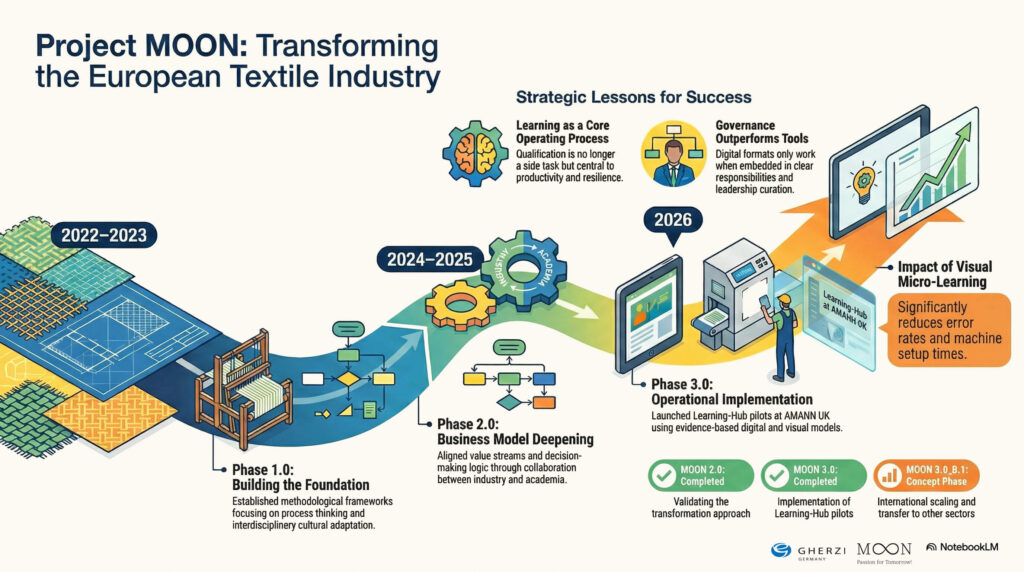
MOON 1.0 focused on creating a methodological foundation for transformation projects. Process thinking, interdisciplinary collaboration, and hands-on tools were at the core of this phase. Early project work revealed a crucial insight: technological innovation generates limited impact if organizational structures, decision-making logics, and cultural practices remain unchanged.
This first phase established a shared understanding that sustainable transformation must be treated as an integrated organizational challenge rather than a technology-driven initiative.
Deepening the Approach: MOON 2.0
With this foundation in place, MOON 2.0 shifted the focus from methods to impact. Between 2024 and 2025, the project concentrated on the systematic redesign of business models and end-to-end processes.
A defining characteristic of this phase was the close collaboration between industrial partners, universities, and strategic experts. Together, value streams, decision-making processes, and organizational structures were analyzed and rethought. Transformation was no longer viewed as an abstract strategy exercise, but as a concrete reconfiguration of how work is organized and value is created.
The central lesson of MOON 2.0 was clear: transformation becomes sustainable only when strategy, processes, and organizational design are developed in an integrated and coherent manner.
From Strategy to Reality: MOON 3.0
MOON 3.0 marked a decisive turning point. The project moved from analysis and concept development into operational implementation. The question was no longer what needs to change, but how change can be anchored in daily work.
A key milestone of this phase was the study “In-Company Learning Today”, complemented by the implementation of a Learning Hub pilot at AMANN UK. This work led to the development of an evidence-based model for digital, visual, and shopfloor-oriented learning.
Learning was deliberately embedded into operational processes. Clear governance structures, defined roles and responsibilities, measurable KPIs, and direct links to production performance ensured that learning became a managed and measurable core process rather than an isolated HR activity.
What We Learned Along the Way
Learning as a Core Operating Process
One of the most important insights of Project MOON is that learning is not a supporting function—it is a core operating process. In highly synchronized and complex production environments, structured learning directly affects productivity, quality, and the organization’s ability to adapt under pressure.
Governance Creates Impact
MOON demonstrated that digital tools alone do not create transformation. Impact emerges when learning content is embedded in clear governance structures, continuously maintained, and actively curated by leadership. Managers play a key role not as passive sponsors, but as stewards of organizational knowledge.
The Power of Visual, Short-Form Learning
Short, visual learning formats proved to be particularly effective. Micro-videos, visual standard work, and QR-code-based access at the workplace reduced onboarding times, lowered error rates, and improved operational KPIs such as first-pass yield and changeover times. Learning became immediate, relevant, and directly connected to real work.
Evidence Builds Trust and Enables Scaling
Another decisive lesson was the importance of measurability. By linking learning analytics with production KPIs, MOON was able to demonstrate tangible impact. This evidence was essential for management acceptance and provided a solid basis for scaling learning concepts across sites and functions.
Designing for Transferability
From the beginning, MOON was deliberately designed as a non-profit, industry-open program. This ensured that models, methods, and insights were transferable beyond individual pilot companies, significantly increasing the project’s economic and societal value.
Where the Project Stands Today
By January 2026, MOON 2.0 had been successfully completed and its transformation approach validated. MOON 3.0 delivered a finalized report and a fully implemented Learning Hub pilot at AMANN UK.
Building on these results, follow-up and transfer projects (MOON 3.0_A.2 and MOON 3.0_B.1) have been designed. Their focus lies on internationalization, scaling, and transferring the approach to additional organizational areas.
A Broader Impact Beyond Individual Companies
Project MOON fulfills the criteria of a non-profit funding initiative in a particularly strong way. Its objective has never been to create isolated, company-specific solutions, but to develop transferable standards, learning models, and organizational practices for the textile and manufacturing industries as a whole.
With the support of the Hanns A. Pielenz Foundation, MOON activated a transformation process in which companies became active co-creators rather than passive recipients of results. Leaders and employees were directly involved in studies, pilots, and co-creation formats, ensuring that new organizational, learning, and leadership models were tested under real industrial conditions.
The resulting insights have been scientifically grounded, translated into practical operating models, and made openly accessible. In doing so, MOON contributes to strengthening productivity, qualification, and resilience across companies of different sizes and maturity levels—creating lasting value well beyond the immediate project partners.